
# treg.to/social - one API for social data, filtered by Jev, at 0% markup
If you run social media monitoring through an AI agent, you know the pain: separate API for X, separate for TikTok, separate for Instagram, separate for Reddit, each with its own pricing, rate limits and authentication. Then the agent has to read every post and decide whether it matters, which costs tokens and time.
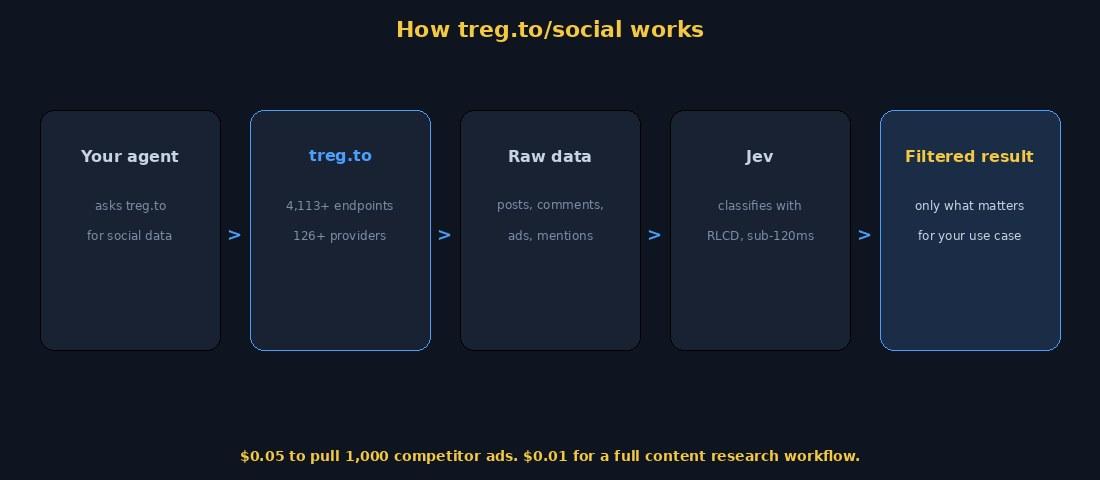
treg.to/social solves both sides. It unifies 4,113+ endpoints across 126+ data providers behind one API key, passes through access at 0% markup over wholesale cost, and pairs every data pull with Jev, a classification model that runs in under 120 milliseconds with exactly zero schema errors.
What treg.to is
treg.to calls itself "OpenRouter for Agent Tools." Instead of routing model requests across providers, it routes tool calls across 126 upstream data providers at wholesale prices. You deposit prepaid credits ($10, $50 or $500), and every API call costs exactly what the upstream provider charges, with zero markup.
It covers every major social platform with read and write endpoints:
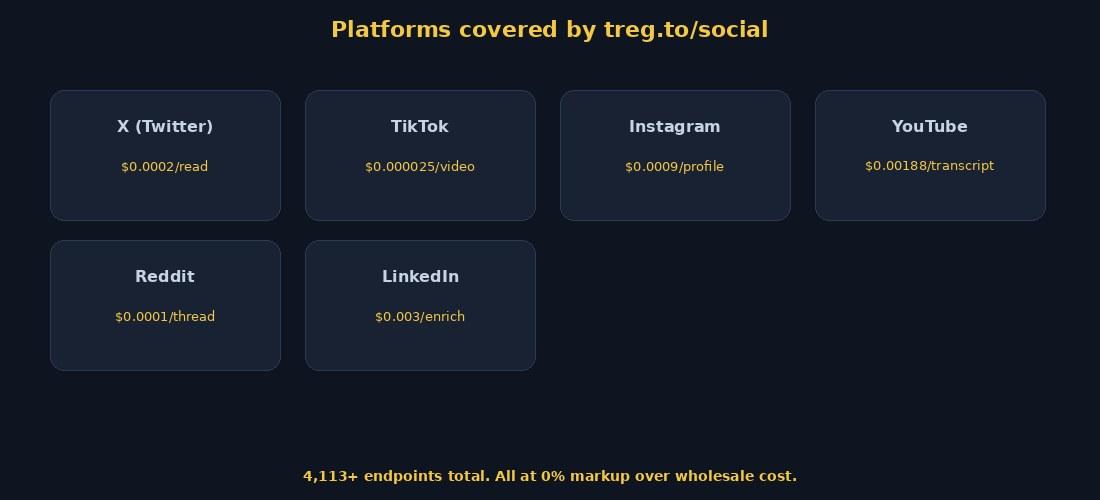
| Platform | Read cost | Write cost | |---|---|---| | X (Twitter) | $0.0002 / read call | Free (OAuth) | | TikTok | $0.000025 / video record | Free | | Instagram | $0.0009 / profile audit | Free | | YouTube | $0.00188 / full transcript | Free | | Reddit | $0.0001 / thread | Free | | LinkedIn | $0.003 / profile enrich | Free |
What Jev is
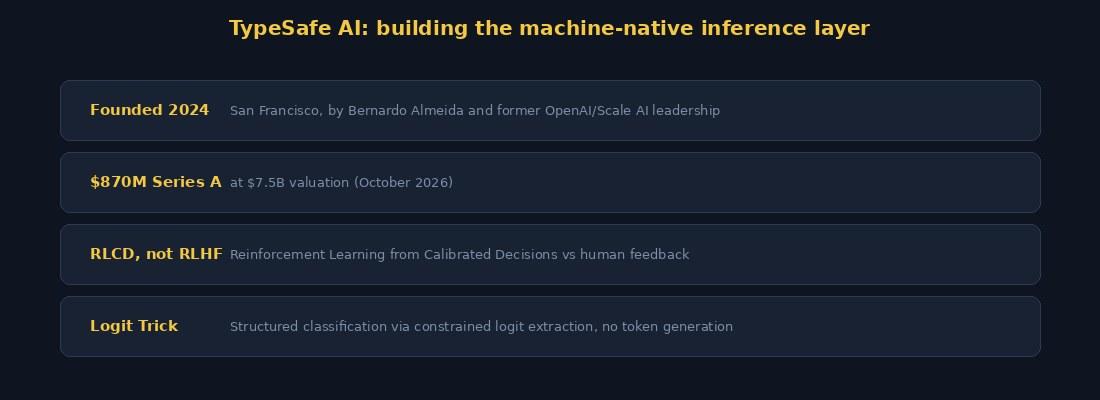
Jev is a non-autoregressive classification model from TypeSafe AI, a company founded in 2024 by former OpenAI and Scale AI leadership. It raised $870M at a $7.5B valuation in October 2026. Instead of RLHF (Reinforcement Learning from Human Feedback, which optimizes for conversational agreeableness), Jev was trained using RLCD (Reinforcement Learning from Calibrated Decisions), which optimizes for mathematical accuracy on structured classification tasks.
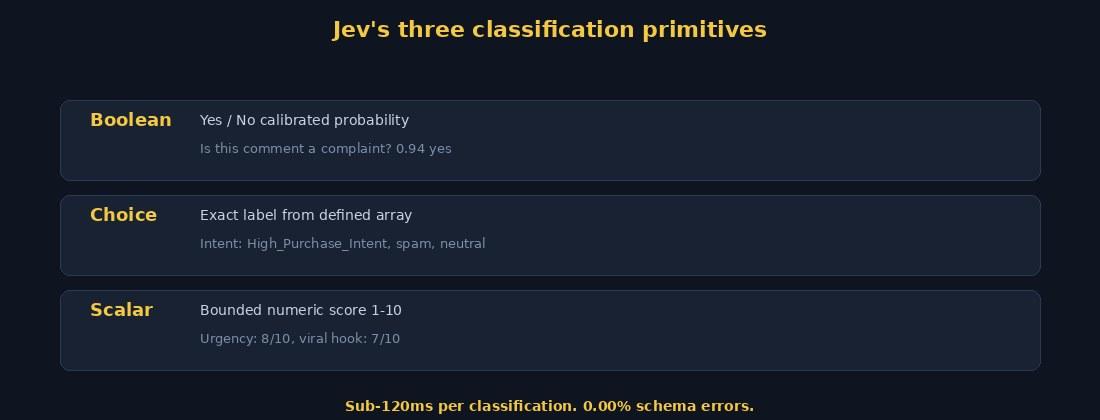
The "Logit Trick" is the crux: rather than running an autoregressive forward pass to generate words, Jev evaluates the raw logits of the vocabulary space constrained strictly to the schema dimensions. It outputs calibrated probability vectors, not conversational text.
The cost comparison
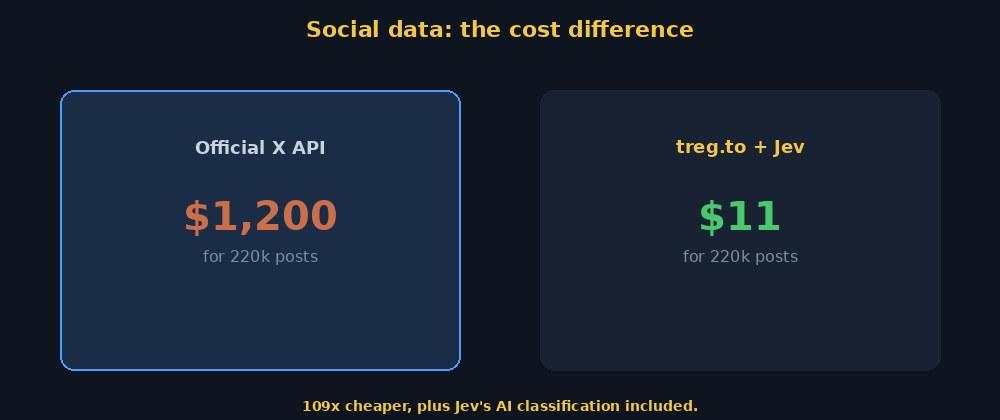
A concrete case: Jason Zhou used treg.to + Jev to analyze 220,000 social posts. The cost was $11. Using the Twitter official API alone, the same volume would cost $1,200 (at $0.005 per post). The 109x difference comes from treg's wholesale pricing across multiple platforms and Jev's token-free classification - no output tokens to pay for.
The architecture
The design is a clear separation between data ingestion and decision calibration:
1. An agent calls treg.to with a request for social data (competitor mentions, trending posts, ad monitoring). 2. treg.to routes through one of its 126+ providers at wholesale cost. 3. The raw data (posts, comments, ads) comes back. 4. The agent sends it to Jev for classification, asking questions like "Is this a complaint?" or "What is the purchase intent?" 5. Jev returns calibrated probability arrays in under 120 milliseconds. 6. The agent only processes what passes the filter.
For content research workflows, this means a full competitive analysis that used to cost thousands of dollars a month and multiple API subscriptions can run for less than a dollar.
What it means for Argo
Our daily social pipeline (argo-daily-update, media kits, content calendars) monitors mentions, posts and trends across platforms. Today that is a manual process. A treg.to + Jev integration would mean an agent can pull competitor data, classify every post by relevance, and surface only the posts that need human attention, at a cost of pennies per run.
The write endpoints (free at 0% markup) also mean the agent can publish directly to X, Instagram, LinkedIn and YouTube from a single API, without managing per-platform tokens. The OAuth vault keeps credentials encrypted and separate from the agent's context.
The repo
treg.to is open source. Try it at treg.to/social.