
Most guides to a personal knowledge base open with a diagram and close with a command you have to adapt. The engine behind our second brain now ships the first ten minutes as a skill instead: a folder with a SKILL.md that tells an agent how to build the vault. You answer four questions, it runs the steps, and it checks each one before the next.
We put the skill in the open-source engine, where the guard hooks and the shared skills live, and pointed the ways you would arrive at it at it: a button on the home page, a page of its own, and a raw file an agent can fetch. This is the practical version: what it asks, what it runs, what it refuses to touch, and where to get it.
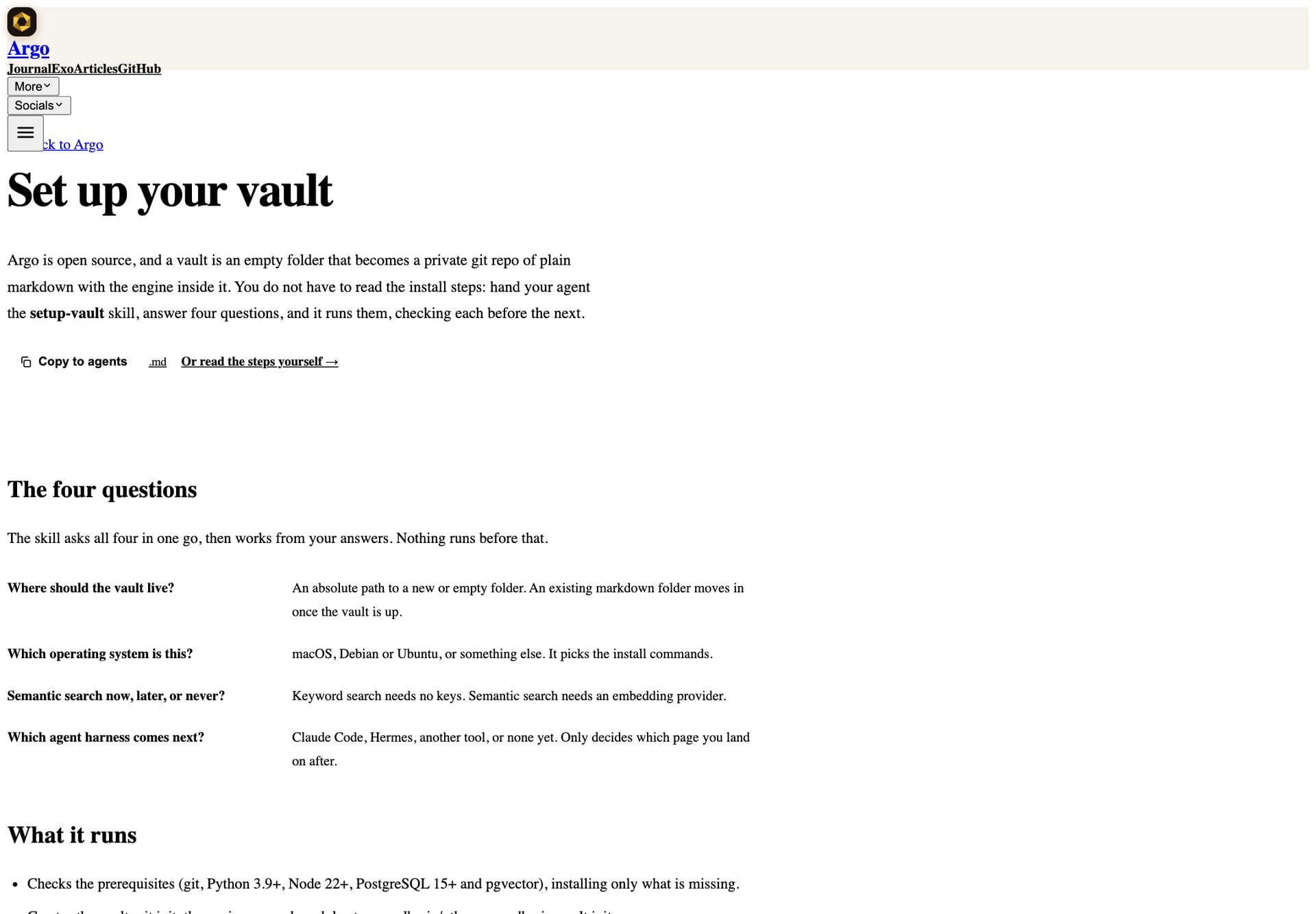
The four questions
The skill asks all four in one batch, because everything after depends on the answers. Nothing runs until they are in.
- Where the vault lives. An absolute path to a new or empty folder. The setup refuses a folder that already has content, so an existing notes folder moves in later, once the vault is standing.
- The operating system. macOS, Debian or Ubuntu, or something else. It decides which install commands run, and nothing else.
- Semantic search now, later or never. Keyword search needs no keys. Semantic search needs an embedding provider, so it is asked once and skipped by default.
- Which agent harness comes next. Claude Code, Hermes, another tool, or none yet. It only decides which page you land on after the vault is up.
What it runs
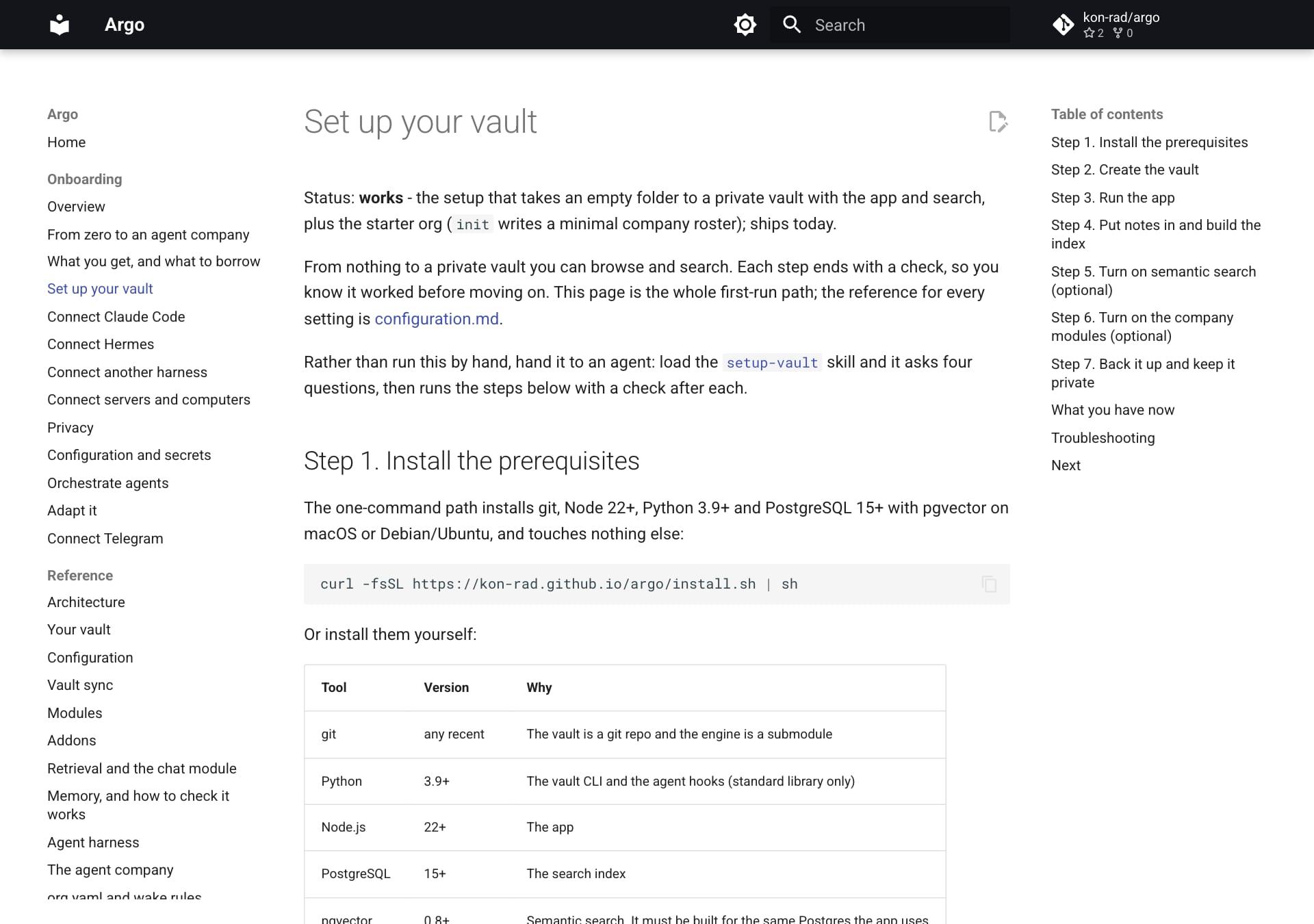
Then it walks the same path the documentation describes, one command at a time, checking after each so a failure is caught where it happened rather than three steps later.
- Prerequisites. git, Python 3.9 or later, Node 22 or later, PostgreSQL 15 or later and pgvector. It checks what is already installed and installs only what is missing.
- The vault. git init, the engine as a submodule at .secondbrain, then secondbrain-vault init, which writes the folders, the rules and a starter roster.
- The app. One command builds and starts it on 127.0.0.1:5123, and the launcher goes on your PATH.
- Your notes. Move markdown in, then scan. The scanner skips .env files, keys and certificates, so credentials are never indexed or served.
- Search. Keyword search works immediately; semantic search is one key or one local model away, if you asked for it.
- A private remote. It pushes the vault to a remote and checks that .env is ignored before that push.
What it deliberately leaves alone
The skill stops the moment the vault runs and search works. It connects no agent harness, turns on no optional module, and sets up no server, and it says so when it reports back. Those are separate pages, and you read them when you want them. A setup that tries to do everything is a setup that fails somewhere you cannot see.
Getting it
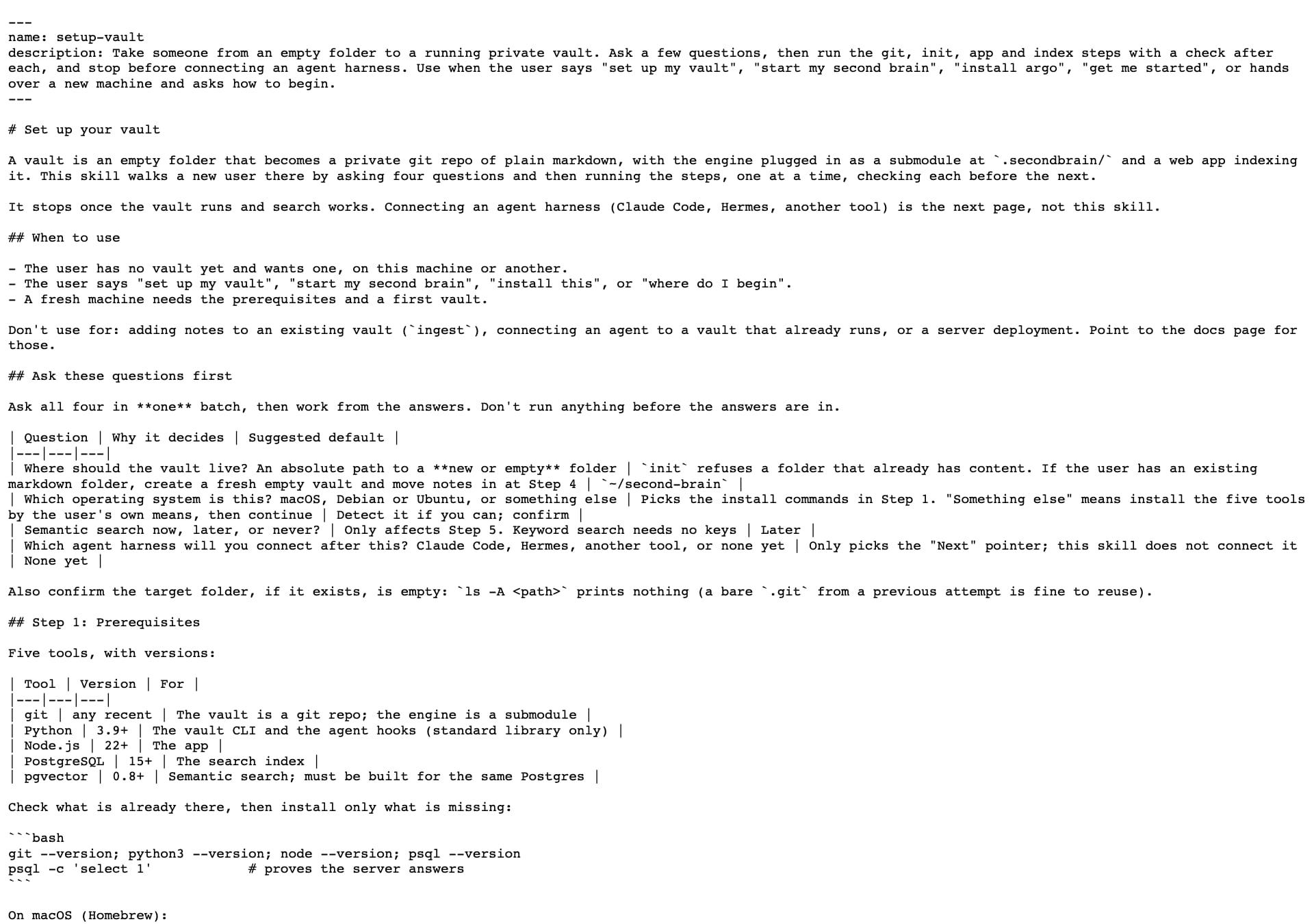
The skill is in the engine at github.com/kon-rad/argo, under skills/setup-vault. On the site it is at myargoquest.com/setup-vault.
An agent can fetch the raw file at /setup-vault/skill.md, the same shape as the blog's own skill at /blog/SKILL.md: markdown, no key, no login. It is listed in our llms.txt, so an agent that reads that file finds it without being told.
What you end up with
A private git repo of markdown, the app over it, search, and a starter roster you can ignore until you want it. The notes are the only irreplaceable part, and they are plain files in a repo you own.
Why a skill and not a script
A script has to guess your operating system, your paths and your database, and it breaks quietly when it guesses wrong. An agent has a conversation: it can see the machine, ask the four things it cannot see, and stop and say so when something does not add up. The steps are still written down, in a file you can read and version. They are just executed by something that can adapt when your machine differs from the one in the instructions.
If you want your own, press Set up your vault on the home page, or hand your agent /setup-vault/skill.md.